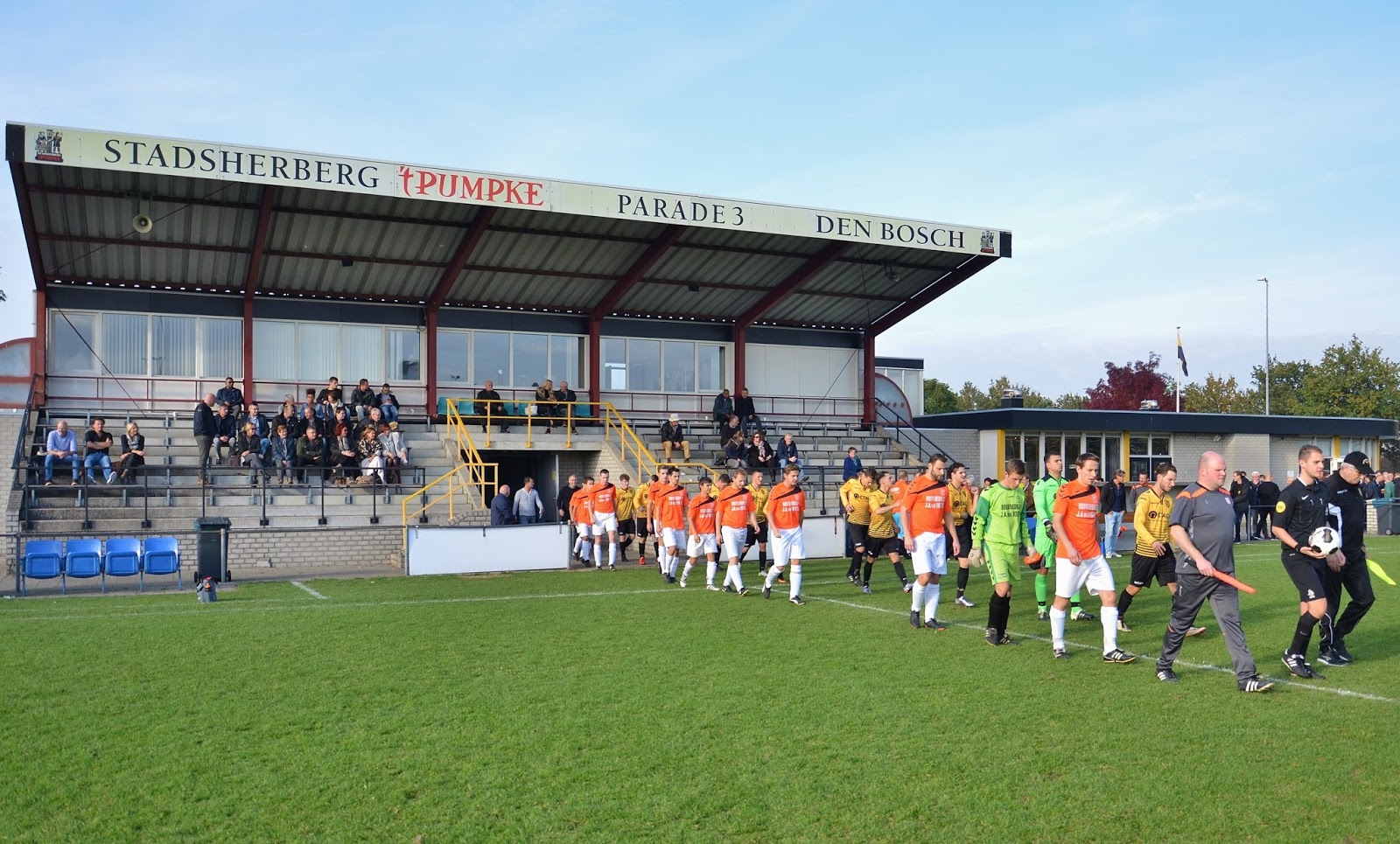
Gemeentelijk Sportpark De Pol Oost I, Gaanderen (formerly VVG '25)
Netherlands, province: Guelders = Gelderland
October 2016 / no match visited
Timeline
- 1925 / Foundation of no fewer than three football clubs in Gaanderen, a village in the Province of Guelders (Gelderland), to the south of Doetinchem; first, there is vv Gaanderen, a non-confessional club, which joins the so-called Geldersche Voetbalbond (GVB), the Guelders sub-branch of the official Netherlands’ Football Association (NVB, later KNVB). Furthermore, two Roman Catholic clubs see the daylight, GVV (Gaandersche Voetbalvereeniging) and GVC (Gaandersche Voetbalclub), with the latter taking on the name Eendracht later on – probably already in 1925 or 1926. Both of these clubs join the RKUVB (Roomsch-Katholieke Utrechtsche Voetbalbond), one of the sub-branches of the Roman Catholic Football Federation (RKF). In those early days, football is being played on pastures around Gaanderen, with sources mentioning locations such as Terrein Oude Möl (Hogeweg), Terrein Jan Geurtsen (Kerkstraat), and Terrein Café Waarbroek, nicknamed Bij Willem in de Bult.
- 1929 / With Eendracht having had to cease its activities due to no longer disposing of a suitable pitch, a merger is concluded between Eendracht and GVV, leading to the foundation of Roomsch-Katholieke Sportvereniging (RKSV) VVG (Voetbalvereeniging Gaanderen). The merger is concluded under the aegis of the village priest, Fr Van Roggen, and his chaplain, Fr Mathijssen. With gymnastics and athletics also being added to the activities, Mr Hettinga is named at the first chairman of the newly founded merger club. RKSV VVG probably started its activities at Terrein Huitink, also referred to locally as Terrein Tergun, at Rijkschweg. Also in 1929, the non-confessional vv Gaanderen is wound up, ceasing all activities.
- 1930 / RKSV VVG wins its first title in the RKUVB, winning promotion to RKF National Division 2 – renamed IVCB National Division 2 in 1932.
- 1933 / As RKSV VVG wins a title in IVCB National Division 2, the club runs into problems due to one or two of its players turning out not to be members of the village’s Roman Catholic parish. This even leads to the title being withdrawn from VVG by federation authorities. Thereupon, all non-Catholics are thrown out, which leads to the foundation of a new non-confessional club in Gaanderen. This newly formed vv Gaandersche Boys (renamed vv Gaanderense Boys in 1945) joins the GVB.
- 1937 / Relocating from Terrein Huitink, RKSV VVG settles at a newly laid-out pitch at Vreeltstraat, at the back of the local state-run primary school.
- 1938 / After one season at Terrein Vreeltstraat, RKSV VVG moves to a new pitch at the crossroads of Hoofdstraat and Pelgrimstraat, laid out on a plot of farmland owned by J.A. Arts. The new park, which does not dispose of a clubhouse in the first 25 years of its existence, is renamed Sportpark Den Elshof subsequently.
- 1940 / Having spent the first decade of its existence in the ranks of the RKF (IVCB) and its sub-branch RKUVB, RKSV VVG is now constrained to make the step to the official Netherlands’ FA (KNVB, renamed NVB following the German oppression of the Netherlands in May 1940, with the royal epithet ‘koninklijk’ being withdrawn for obvious reasons) as all other football associations are abolished by German occupation authorities. Having played at the level of IVCB National Division 2 in its last pre-war season, the club is placed in KNVB District East’s Sunday League 4 for the 1940-41 season.
- 1941 / At the behest of NVB authorities, who frown upon two clubs bearing the same name, RKSV VVG takes on the new name (RKSV?) VVG ’25 to avoid confusion with the older VVG from Groningen.
- 1942 / VVG ’25 finishes as runner-up in District East’s Sunday League 4H, 3 points behind champions vv Gendringen.
- 1944 / VVG ’25 finishes as runner-up in District East’s Sunday League 4K, 2 points behind champions vv Sint-Joris.
- 1946 / Champions in District East’s Sunday League 4L, 6 points ahead of closest followers MvR, VVG ’25 fails to book a ticket for Sunday League 3 in the subsequent round of championship play-offs.
- 1947 / Champions in District East’s Sunday League 4L, 4 points ahead of closest followers MvR, VVG ’25 goes on to win promotion to Sunday League 3 in the subsequent round of championship play-offs along with SV Epe, at the expense of BIC, vv Terborg, and EBON. A 3-2 away win at BIC proves decisive in the quest for promotion.
- 1949 / VVG ’25 finishes as runner-up in District East’s Sunday League 3C, 1 point behind champions SC Varsseveld.
- 1950 / VVG ’25 finishes as runner-up in District East’s Sunday League 3D, 6 points behind champions vv Dierense Boys. Also in 1950, Sportpark Den Elshof sees the inauguration of a wooden main stand, with 330 covered seats, with Fr Pelgrim, the village priest, performing the official ceremony.
- 1952 / Champions in District East’s Sunday League 3C, 2 points ahead of closest rivals Sportclub Silvolde and without suffering a single defeat all season, VVG ’25 fails to book a ticket for Sunday League 2 in the subsequent round of championship play-offs.
- 1953 / VVG ’25 finishes as runner-up in District East’s Sunday League 3C, 10 points behind runaway champions ESCA.
- 1956 / VVG ’25 finishes as runner-up in District East’s Sunday League 3C, 4 points behind champions VDZ.
- 1958 / Finishing bottom of the table in District East’s Sunday League 3C, VVG ’25 drops back into Sunday League 4 after eleven seasons.
- 1961 / Champions in District East’s Sunday League 4E, 2 points ahead of closest rivals RKVV DVC ’26, VVG ’25 manages a return to Sunday League 3.
- 1963 / A clubhouse is erected at Sportpark Den Elshof.
- 1965 / As VVG ’25 celebrates its fortieth anniversary, the club takes on a team of professional league players from eastern clubs, including Abe Lenstra of SV De Enschedese Boys.
- 1968 / VVG ’25 is joined by former NEC and BV De Graafschap goalkeeper Dick Wennink. Wennink, who had started a job as a teacher at the local state-run primary school in Gaanderen, would only stay at Sportpark Den Elshof for one season, hanging up his boots in 1969.
- 1970 / Finishing in second-last place in District East’s Sunday League 3C, VVG ’25 descends into Sunday League 4 along with bottom club SV Grol. That same year, Sportpark Den Elshof is purchased by the municipal authorities of Gaanderen.
- 1973 / Finishing bottom of the table in District East’s Sunday League 4C, VVG ’25 descends into the ranks of GVB Sunday Division 1 for the first time in club history. On the upside, the year 1973 sees the club move to the new Gemeentelijk Sportpark De Pol – in fact situated right next to the old Sportpark Den Elshof, which had to make way for the new local sports hall. The new main pitch is inaugurated by former club secretary and former alderman Frans Ernst in August 1973.
- 1974 / With the new clubhouse being finished in February 1974, the new Gemeentelijk Sportpark De Pol is officially inaugurated three months later with a gala match, in which a team of regional non-league players takes on BV De Graafschap (3-10, att. 1,500). The new park consists of three pitches and a large covered grandstand alongside the main pitch. Simultaneously, village rivals vv Gaanderense Boys moves into Sportpark De Pol as well, being given the luxury of two pitches at the western end of the park.
- 1977 / After four years in the ranks of the GVB, VVG ’25 manages a return to Sunday League 4.
- 1985 / As the club celebrates its sixtieth anniversary, VVG ’25 takes on BV De Graafschap and AVC Vitesse in two gala matches in the summer of 1985, conceding nine and ten goals respectively against these professional league sides.
- 1990 / Finishing in second-last place in District East’s Sunday League 4C, VVG ’25 drops back into GVB Sunday Division 1 along with bottom club Sportclub Eibergen.
- 1991 / VVG ’25 manages a return to Sunday League 4 after only one season in the ranks of the GVB.
- 1992 / Finishing in second-last place in District East’s Sunday League 4D, VVG ’25 drops back into GVB Sunday Division 1 along with bottom club vv VIOD.
- 1995 / After three years in GVB Sunday Division 1, VVG ’25 now manages a return to Sunday League 4.
- 1996 / The wooden benches on the grandstand of VVG ’25 at Sportpark De Pol are replaced by 330 plastic seats, which had previously featured at Stadion de Vijverberg in Doetinchem.
- 2000 / As VVG ’25 celebrates its 75th anniversary, the club takes on Feyenoord Rotterdam in a gala match at Sportpark De Pol Oost (1-10, att. 3,000).
- 2004 / VVG ’25 finishes as runner-up in District East’s Sunday League 4C, 8 points behind champions vv Ulftse Boys. That same year, vv Gaanderense Boys ceases all activities, with that club’s two pitches at Sportpark De Pol West becoming Pitch/Veld 4 and Pitch/Veld 5 of VVG ’25.
- 2005 / VVG ’25 finishes as runner-up in District East’s Sunday League 4C, 1 point behind champions vv Gendringen.
- 2006 / Coached by André Wevers, who replaced René Hiddink in the course of the season, VVG ’25 finishes in second-last place in District East’s Sunday League 4C, thus descending into Sunday League 5 along with bottom club vv Ruurlo.
- 2008 / Coached by Mark Rutten, who replaced Frits van der Worp in the course of the season, VVG ’25 clinches the title in District East’s Sunday League 5C, 7 points ahead of closest followers vv VIOS Beltrum. As such, the club wins promotion to Sunday League 4.
- 2010 / Former VVG ’25 youth academy defender Ties Evers makes his professional league debut at BV De Graafschap. Evers goes on to have subsequent spells at AGOVV Apeldoorn and FC Volendam, bowing out into non-league with VVSB in 2019.
- 2011 / Finishing in third place in District East’s Sunday League 4D, VVG ’25 qualifies for the promotion play-offs, in which the club is knocked out in R1 by RKZVC (2-1 aggr.).
- 2012 / Coached by Ferhat Ozerdogan, VVG ’25 finishes in second-last place in District East’s Sunday League 4C, going on to suffer defeat in R1 of the promotion-relegation play-offs against vv Ulftse Boys (4-1 aggr.). As a result, VVG ’25 drops back into Sunday League 5 along with bottom club RKVV Ajax-B.
- 2013 / Finishing in fifth place in District East’s Sunday League 5C, VVG ’25 goes on to defeat vv Vosseveld in the promotion play-offs (6-1 aggr.). As a result, the club manages a return to Sunday League 4 after just one season. The successful coach is Bas van Londen.
- 2014 / Coached by Bas van Londen, VVG ’25 finishes in second-last place in District East’s Sunday League 4C, thus dropping back into Sunday League 5, along with SV Dinxperlo, vv Terborg, and bottom club vv DEO.
- 2015 / Finishing in fifth place in District East’s Sunday League 5D, VVG ’25 goes on to defeat vv Hoeve Vooruit in the promotion play-offs (5-2 aggr.). As a result, the club manages an immediate return to Sunday League 4. The successful coach is Theo Besselink.
- 2016 / As a complete renovation of Gemeentelijk Sportpark De Pol gets underway, a new – synthetic – main pitch is laid out at the other, western, side of the clubhouse, which is knocked down later that same year. The old main pitch has to make way for the new clubhouse.
- 2017 / As the facelift of Gemeentelijk Sportpark De Pol is completed, the new MFA (‘Multi-Functionele Accommodatie’) is inaugurated, featuring a clubhouse with an uncovered stand, with the two primary schools in Gaanderen – the state-run as well as the Roman Catholic school – being housed in another part of the same building. The new park consists of three pitches – including the two former vv Gaanderense Boys pitches – and a smaller training pitch.
Note – Part of the information above has been derived from a magazine published on the occasion of the 100th anniversary of VVG ’25 in 2025: “Jubileumuitgave VVG ’25. 100 joar springlèavend.”
All photos: (c) W.B. Tukker / www.extremefootballtourism.blogspot.com. Publication of any of these images only after permission of author


 All photos: (c) W.B. Tukker / www.extremefootballtourism.blogspot.com. Publication of any of these images only after permission of author